
Compare CU40 Car Insurance Quotes
- Steering Offence Considered
- Prices Can Settle Down
- More Than Basic Cover
- Less Ringing Round

CU40 Conviction: Points, Ban And Years On Your Licence
Yes, you can usually get car insurance with a CU40, through specialist brokers who search for insurers that consider construction and use offences. A CU40 is for using a vehicle with defective steering, and it carries 3 points. It stays on your licence for 4 years from the offence date, or from conviction if the court bans you.
- Points 3 Unless the court bans you instead.
- On your licence 4 years From the offence date, or from conviction if you're banned.
- Ban Possible Not automatic: the court can ban you for any offence with points.
- Insurers may see it 4 years Any time while it's on your record.
It can be dealt with by a fixed penalty or in a magistrates' court, where the maximum is a £2,500 fine, or an unlimited fine for a goods vehicle or one adapted to carry more than 8 passengers. There's no prison sentence for it.
What Is A CU40 Motoring Conviction?
CU40 is the endorsement code for using a vehicle with defective steering. GOV.UK's endorsement code list gives it 3 penalty points, and it stays on your driving record for 4 years from the date of the offence, or from conviction if the court bans you.
The law on brakes, steering and tyres makes it an offence to use a vehicle on a road when it doesn't meet the construction and use rules on steering, or to cause or permit someone else to use it. So the owner or employer who sent the vehicle out can be prosecuted, as well as the driver.
Defective brakes (CU10) and defective tyres (CU30) come under the same law. A vehicle, or other parts of it, in a dangerous condition is CU20.
New Drivers With A CU40
A CU40 on its own won't cost a new driver their licence, but it leaves little room. GOV.UK's guide to penalty points for new drivers says your licence is cancelled if you get 6 or more points within 2 years of passing your test, so one more 3-point offence would be enough.
A CU40's points count towards totting up for the first 3 of the 4 years it's on your record: 12 or more points within 3 years normally means a ban of at least 6 months.
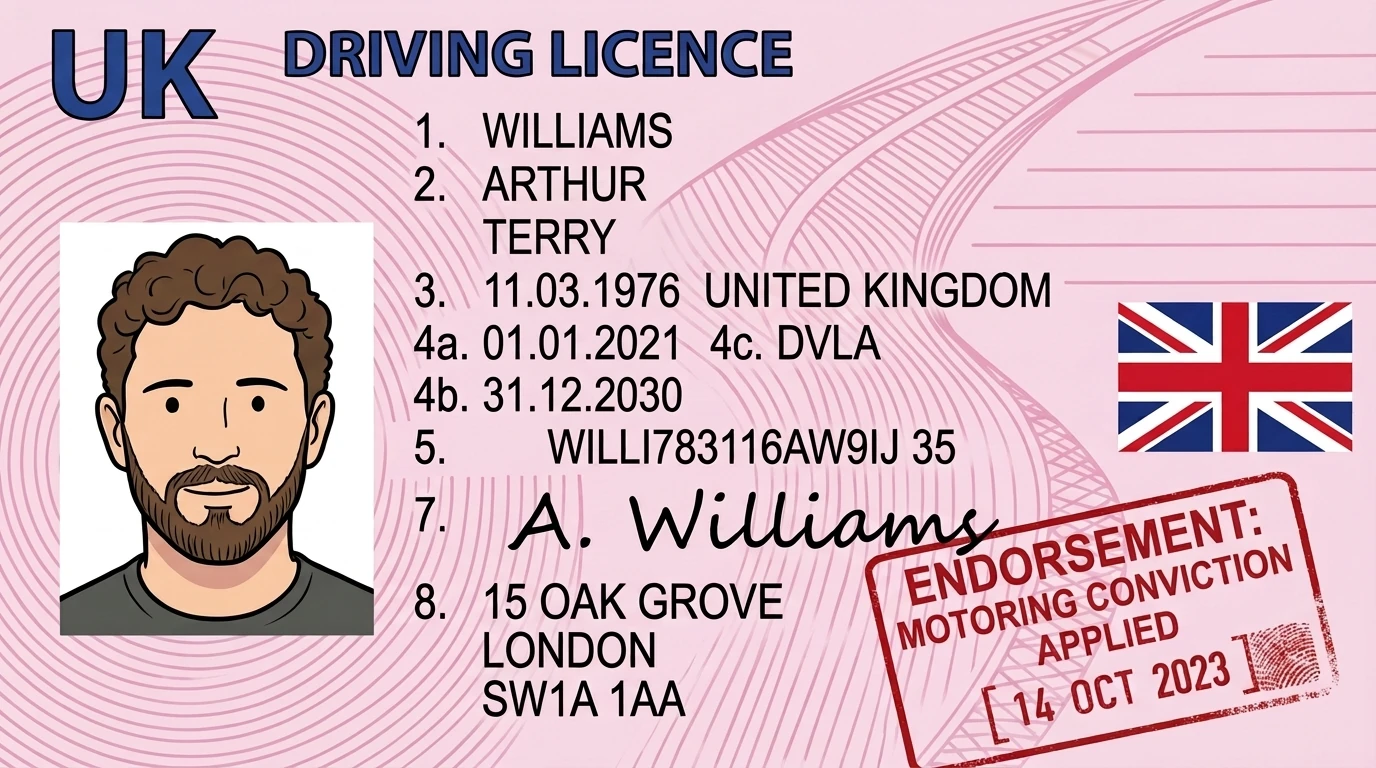
How A Steering Fault Becomes A CU40
A CU40 is about the state of the steering, not how the car was driven. It may be found at a roadside check. The Highway Code asks you to take special care that the lights, brakes, steering and other safety parts are all working.
No Points If You Didn't Know About The Fault
The law gives one way out of the points. If you prove that you didn't know, and had no reasonable cause to suspect, that the facts were such that the offence would be committed, the court must not endorse your licence or ban you, so no CU40 goes on your record. You'd still be convicted and could still be fined, and it's for you to show this. The court decides it, so it only helps if the case goes to court.
More Than One Defect At The Same Stop
If you're convicted of more than one endorsable offence from the same occasion, the points aren't normally added together. The law says you get the points for the highest one, unless the court decides otherwise.
A Fixed Penalty Or A Court Case
A CU40 is on the list of fixed penalty offences, so the police can offer a fixed penalty instead of a court case. That isn't available to someone charged with causing or permitting another person to use the vehicle. GOV.UK says a fixed penalty notice can mean a fine of up to £200 and penalty points. If it goes to court, the Sentencing Council's defective steering guideline starts at a band B fine for a driver, which is about a week's income, within a range from a discharge to a band C fine. The maximum is £2,500, or an unlimited fine for a goods vehicle or a vehicle adapted to carry more than 8 passengers.
Sources: the Road Traffic Act 1988 and the Road Traffic Offenders Act 1988, including the no-points rule for unknown defects, checked 15 October 2026. Endorsement codes and processes in Northern Ireland are different.
This information is based on our understanding of current law and insurance practice at the time of writing. Rules, penalties and rehabilitation periods can change and may apply differently depending on individual circumstances.
Other Construction And Use And Totting-Up Codes
| Code | Offence | Points | On licence |
|---|---|---|---|
| CU10 | Using a vehicle with defective brakes | 3 | 4 years |
| CU20 | Causing or likely to cause danger by reason of use of unsuitable vehicle or using a vehicle with parts or accessories (excluding brakes, steering or tyres) in a dangerous condition | 3 | 4 years |
| CU30 | Using a vehicle with defective tyre(s) | 3 | 4 years |
| CU50 | Causing or likely to cause danger by reason of load or passengers | 3 | 4 years |
| CU80 | Breach of requirements as to control of the vehicle, such as using a mobile phone | 3–6 | 4 years |
| TT99 | Disqualification under the totting-up procedure | None | 4 years |
Can You Get Car Insurance After A CU40 Conviction?
Yes. Specialist brokers can look for insurers that consider a CU40, though not every insurer will quote and prices may be higher while it's recent. Each insurer sets its own rules, but most ask about convictions from the last 5 years. A CU40 leaves your record after 4 years, but for an adult it's only spent 5 years from conviction, so it can still come up at renewal.
If The Court Bans You For A CU40
A CU40 doesn't always mean a ban, but the court can disqualify you for any offence that carries points. The Highway Code says a ban like this will usually be between a week and a few months. If it does, don't drive until the ban has ended. You can compare quotes before then: MIB says to buy your insurance ahead of the date you need the cover to start. GOV.UK says that if you're banned for 56 days or more, you must apply for a new licence before driving again.
Do You Have To Tell Your Insurer About A CU40?
Yes, whenever the insurer's questions cover it, until it's spent. That can include a CU40 from a fixed penalty, if the question asks about endorsements, points or fixed penalties. Give the code, offence date, conviction date and points or ban exactly as your paperwork shows. If you get it during a policy, MoneyHelper says you don't have to declare it until you renew, unless your policy says you must.
What Cover Can You Get With A CU40 Conviction?
Comprehensive cover may still be available through specialist brokers after a CU40. Some insurers may offer only third party, fire and theft or third party cover, or ask for a higher excess or a black box.
Driving a van or riding a motorbike with a CU40? It's on your driving record whatever you drive, so those insurers may ask about it too. See van insurance with a CU40 or motorbike insurance with a CU40.
Please note that policy features, benefits, terms and conditions vary among insurance providers, so always check the policy wording.
Cover Tip: Make sure the cover matches how you use the car. MIB says business trips beyond your commute need business use, and making deliveries needs hire and reward cover.
Telling Your Insurer About A CU40 Conviction
Insurers may be able to find out about a CU40 for the whole time it's on your record, and you'll need to answer their questions accurately until it's spent, which for an adult is later. For timings, read how long to declare a driving conviction.
- Answer The Conviction Questions Accurately - Under the Consumer Insurance (Disclosure and Representations) Act 2012, what an insurer can do about a wrong answer depends on whether it was careless, or deliberate or reckless. MoneyHelper says an insurer can reject a claim if it has reason to believe you didn't take reasonable care to answer its questions truthfully and accurately.
- Insurers May Be Able To See It For 4 Years - GOV.UK says insurers may be able to find out about an endorsement any time during a 4-year endorsement. That's the whole time a CU40 stays on your record. Most insurers' questions go back further, to the last 5 years.
- Expired Points Can Still Need Declaring - The 3 points on a CU40 stop counting towards a totting-up ban after 3 years, but that isn't the same as spent. In one decision, the Financial Ombudsman found a driver had a duty to disclose an endorsement whose points had expired, because it was still within the 5 years the insurer asked about and wasn't spent.
- What Can Happen If Details Are Wrong - The Financial Ombudsman says an insurer might charge more, restrict the policy, settle a claim only in part, or cancel the policy as if it never existed, which means any ongoing claim will be declined.
- When A CU40 Is Spent - For an adult in England and Wales, the endorsement is spent 5 years from conviction (2.5 years if you were under 18), even if the only other penalty was a fine. A CU40 from a fixed penalty counts too: GOV.UK guidance says it can become spent after 5 years. A ban is spent when it ends, so if it runs past the 5 years, the conviction isn't spent until it ends, and in most cases a new conviction before it's spent pushes the date back too. Once it's spent, MoneyHelper says you don't need to declare it, even if you're asked.
How Does A CU40 Conviction Affect Your Insurance Price?
There's no single price for car insurance after a CU40. MoneyHelper says cover might be more expensive with an unspent conviction. These are the things that can shape a quote.
| Key Factor | Impact on your price |
|---|---|
| Other points on your record | A CU40 usually adds 3 points to any others you have. More points may mean a higher price, and 12 or more within 3 years normally means a ban. |
| Whether you were banned | A ban alongside a CU40 may suggest a more serious case to an insurer and may narrow the choice of cover. |
| How long ago it happened | A recent conviction may be priced higher. Don't assume the price falls at every renewal, as each insurer sets its own rules. |
| The car you choose | Its value, power and any modifications all count. MIB says unmodified cars are generally cheaper to insure. |
| Mileage, use and parking | Give a realistic mileage, the right type of use and where the car is kept. MIB says wrong or out-of-date details can leave you uninsured without realising. |
The quotes you get will depend on your own details.
Price Insight: Check your record before you quote. GOV.UK's view your driving licence service lets you check your penalty points, so the CU40 dates and points you give match what an insurer may see.

How Can You Help Reduce Insurance Costs After A CU40 Conviction?
While it's unspent, a CU40 stays in a quote when insurers ask about it, but the details around it are yours to change.
-
Ask About A Black Box Policy
Ask whether a black box policy is offered with a CU40. MIB says telematics policies can reward safe driving with lower premiums over time.
-
Check The Insurance Group First
Check the group before you buy a car. MIB says lower-group cars are typically smaller, cheaper to repair and more affordable to insure.
-
Keep The Excess Affordable
Raise the voluntary excess only to a level you could pay if you claimed. MIB says a higher excess can reduce the premium.
-
Quote Before You Need Cover
MIB says quotes are likely to be lowest 20 to 26 days before your renewal is due, and starting early leaves time to compare.

Expert View On A CU40 Conviction
A CU40 can come from a roadside check rather than from the way you were driving, and that can feel harsh if you didn't know about the fault.
A common mix-up is thinking a fixed penalty is finished with once it's paid. GOV.UK's Rehabilitation of Offenders Act guidance says an endorsement from a fixed penalty is treated as a conviction under the Rehabilitation of Offenders Act and can become spent after 5 years, so it can still be a fair question at renewal.
My rule of thumb: keep the fixed penalty notice or court letter with your insurance documents, so the code, dates and points you give always match your record.
About this page


This page was written by Susan Difford, Co-Founder and Personal Lines Expert, and reviewed by Ian Beevis, Co-Founder and Insurance Expert. Updated 30 October 2026.
CU40 Conviction Insurance Questions
What's The Difference Between CU40, CU10 And CU30?
They're all 3-point codes for vehicle defects under the same law: CU10 is defective brakes, CU30 is defective tyres and CU40 is defective steering. Each stays on your record for 4 years from the offence, or from conviction if you're banned.
Can I Get A Fixed Penalty For A CU40?
Yes. Using a vehicle with defective steering is on the list of fixed penalty offences, so the police can offer one instead of a court case. It still means 3 points and a CU40 on your record, and it still needs declaring until it's spent.
Will I Get Points If I Didn't Know About The Fault?
Not if you can prove it. The court must not endorse your licence or ban you if you prove you didn't know, and had no reasonable cause to suspect, that the facts were such that the offence would be committed. You could still be fined.
Can A CU40 Affect A New Driver's Licence?
Yes, if it takes you to 6 points. If you passed your test in the last 2 years, 6 or more points cancels your licence. A CU40 is 3 points, so one more 3-point offence would be enough. You'd then need a new provisional licence and to pass the theory and practical tests again.
When Is A CU40 Spent?
In England and Wales it's usually spent 5 years after conviction (2 years 6 months if you were under 18), or when any ban ends if that's later. A CU40 leaves your licence sooner, 4 years from the offence, or from conviction if the court bans you. Once it's spent, MoneyHelper says you don't need to declare it, even if you're asked.
As of October 2026. Source: GOV.UK: Penalty points (endorsements), legislation.gov.uk: Rehabilitation of Offenders Act 1974, section 5, MoneyHelper: Getting insurance with a criminal conviction.
What Are The Penalties For A CU40?
3 points, and in court a fine of up to £2,500 for a car, with a higher maximum for goods vehicles and vehicles adapted to carry more than 8 passengers. A ban is up to the court.
As of October 2026. Source: GOV.UK: Endorsement codes and penalty points, legislation.gov.uk: Road Traffic Offenders Act 1988, Schedule 2, legislation.gov.uk: Sentencing Act 2020, section 122.
How Much Does A CU40 Affect Car Insurance?
As at October 2026, Go.Compare's median annual premium for drivers with a construction and use offence was £627 (sales 1 March to 31 May 2026). Its median for drivers with no convictions was £381 (comprehensive cover, 1 January to 30 June 2026). Your own price may be higher or lower.
As of October 2026. Source: Go.Compare convicted driver insurance data (updated 23 September 2026).
Are The Rules On Vehicle Defects Changing?
Not yet. The government's motoring offences consultation (7 January to 11 May 2026) didn't include defective brakes, tyres or steering among its proposals. It did ask whether driving without a current MOT should carry penalty points. No response had been published by 29 October 2026.
As of October 2026. Source: GOV.UK: Proposed changes to penalties for motoring offences.
Who Can Cover You With A CU40?
Specialist convicted driver brokers search for insurers that consider construction and use offences, and you may be able to get quotes from some of them via the Clean Green Cars site. Mainstream comparison sites and insurers you approach direct may also quote, though some may not for a CU40, especially while it's recent. Each broker and insurer has its own range, so prices may differ and it may be worth comparing more than one route.
What Happens After I Submit My Details?
Clean Green Cars introduces you to specialist brokers who consider CU40 convictions. They contact you with quotes based on your details, and you're under no obligation to accept any quote.

What To Have Ready Before Comparing Quotes With A CU40 Conviction
Have these to hand before you get quotes.
- Your CU40 offence date and conviction date
- Whether it was a fixed penalty or a court case
- Your CU40 points, or any ban dates
- Any other points on your record and their dates
- The car's registration, your annual mileage and where it's kept overnight
Get Quotes For A CU40 Conviction

Sources For CU40 Conviction Facts
- GOV.UK: endorsement codes and penalty points - CU40 points and years on your record (checked 15 Oct 2026).
- GOV.UK: how long endorsements stay on your record - when the 4 years start and when insurers may see it (checked 15 Oct 2026).
- Road Traffic Act 1988, section 41A - the offence of using a vehicle with defective steering (checked 15 Oct 2026).
- Sentencing Council: steering defective - the maximum fine, points and starting point (checked 15 Oct 2026).
- GOV.UK: rehabilitation periods - when endorsements and bans are spent (checked 15 Oct 2026).
- Financial Ombudsman: misrepresentation - what an insurer can do if an answer is wrong (checked 15 Oct 2026).
- MoneyHelper: insurance if you have a criminal conviction - why cover may cost more, spent convictions and convictions you get during a policy (checked 15 Oct 2026).
- MoneyHelper: if your insurance claim is rejected - when an insurer can reject a claim over an answer given without reasonable care (checked 15 Oct 2026).