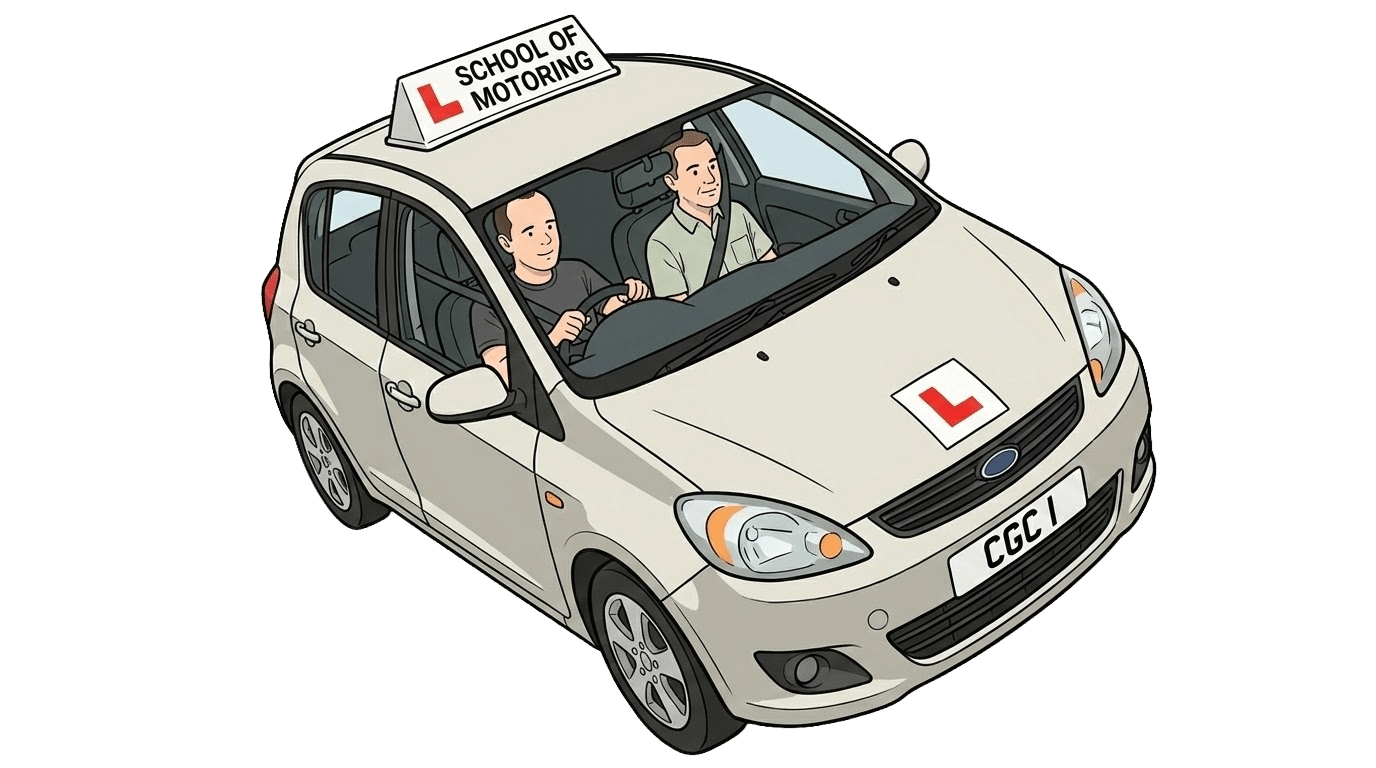
Why Compare Driving School Insurance?
Instruction Use Isn't Always Confirmed
a generic commercial car policy may not explicitly confirm learner-at-wheel cover. Clean Green Cars connects you to specialist brokers who quote policies where instruction use is clear in the wording, not buried in a footnote.
Fleet Pricing Varies A Lot
a broker who regularly insures driving school fleets prices learner incident risk differently from one treating your cars like a standard hire fleet. Clean Green Cars puts you in touch with specialists who could offer a meaningfully different per-vehicle rate.
Your Instructor Mix Affects Your Rate
named instructor vs any qualified instructor, ADI experience and claims history all shift your premium. Clean Green Cars is an FCA-regulated introducer that connects you to brokers who can structure your policy around your actual team, not the most expensive default.
- Built for Instruction Use - your standard car policy may not cover a learner at the wheel. Driving school insurance includes that use class so your lessons are covered from day one.
- Fleet or Single Vehicle - if you run several instruction cars, a fleet policy keeps them all under one arrangement. A sole instructor with one car gets a single vehicle rate with instruction use included.
- Both Parties Covered on the Road - your road risk cover applies while the learner is driving. If a pupil clips a kerb and damages a third party's car, your policy responds.
- Different From Sole Instructor Cover - driving school insurance is usually for school operators with a fleet of vehicles. Individual driving instructor insurance covers one car for one instructor. The products overlap in name but differ in structure.
- Click the green button above to compare quotes today.

Do I Need Car Insurance?
Any vehicle used to give paid driving instruction on a UK public road must carry motor insurance that covers that use class. A standard social or business use car policy doesn't extend to a learner at the wheel. Teaching without the correct cover is a criminal offence under the Road Traffic Act 1988 s.143, no matter whether you hold an Approved Driving Instructor (ADI) badge. If you run a driving school fleet, a specialist fleet policy is the most practical way to cover all your instruction vehicles under one arrangement. Clean Green Cars puts you in touch with specialist brokers who understand instruction use class and can find appropriate cover options for your school.
- Road Risk Cover Is a Legal Must - every instruction vehicle you use on a public road must carry at minimum third party cover, with use class declared as driving tuition or instruction use.
- Your ADI Badge Doesn't Replace Insurance - being on the DVSA Approved Driving Instructor register is required to give paid instruction, but it doesn't substitute for motor insurance. You need both independently.
- Fleet Policies Cover Your Vehicles, Not Your Instructors - a school operator taking out a fleet policy covers the vehicles. Each instructor should check whether they're a named driver or whether any qualified instructor cover applies to their use.
- Franchise and Council Contracts May Require Public Liability - some driving school franchises and local authority contracts require you to hold public liability cover as a condition of the arrangement. This is often separate from your motor fleet policy.
Choosing an unsuitable level of cover could leave you paying out of pocket after a learner-caused incident. Here's what each level of driving school insurance may include. Please note that policy features, benefits, terms and conditions vary among insurance providers, so always check the policy wording.
| Feature | Comprehensive | Third Party, Fire and Theft | Third Party Only |
|---|---|---|---|
| Damage to your instruction vehicle | Yes | No | No |
| Fire and theft of your vehicle | Yes | Yes | No |
| Damage to other vehicles or property | Yes | Yes | Yes |
| Injury to third parties | Yes | Yes | Yes |
| Learner at wheel covered | Yes, if declared | Yes, if declared | Yes, if declared |
| Windscreen repair | Often included | Rarely | No |
| Instructor personal accident | Sometimes | No | No |
| Public liability | Sometimes | No | No |
| Replacement instruction vehicle | Optional | Optional | No |
Cover features depend on insurer terms, the number of vehicles on your fleet schedule and how your instructors are recorded on the policy. If your school uses support vehicles alongside instruction cars, you may also want to explore van insurance for those separately.
Cover Tip: If your insurer provides a replacement vehicle when a fleet car is in for repair, check whether your policy extends the instruction use class to that replacement. A standard garage courtesy car often won't carry your instruction use declaration, which could leave your lessons cancelled while your car is being fixed.
One undeclared instructor or a vehicle used outside your declared use class could leave a claim unpaid at the worst possible moment. Here are the key exclusions and limitations to watch for on your driving school policy.
Standard Exclusions
- Instructors Not Named or Not Meeting Policy Criteria - Your road risk cover applies to instructors named on your policy or who meet the any qualified instructor criteria set by your insurer. If a new instructor starts giving lessons before you add them, your insurer may decline a claim involving that instructor.
- Non-Instruction Use Without an Endorsement - If you use an instruction vehicle for personal journeys or school runs without a private use extension, your insurer may decline a claim that occurs during that use. Check your declaration of use carefully before driving outside tuition hours.
- Dual-Control Equipment Not Declared - If you don't declare your fitted dual-control brake and clutch equipment as a change, a claim involving that equipment could be complicated at settlement. Always declare dual-control systems when you get your quote.
- Track Days or Off-Road Use - Your standard driving school policy covers road use for instruction purposes. Off-road advanced driving courses, skid pan sessions and track day use often need a separate endorsement or a standalone policy.
Important Limitations
- Pupils Without a Valid Provisional Licence - Giving paid instruction to a pupil who doesn't hold a valid provisional licence, or who is under the minimum driving age of 17, could mean your insurer declines a road risk claim arising during that lesson.
- Vehicles Not Listed on Your Fleet Schedule - A fleet policy covers only the vehicles on your schedule. If you add a new instruction car without telling your insurer first, that car could be uninsured from its first day of use until it appears on the schedule.
Optional Extras Worth Adding
Your fleet road risk policy is designed to cover the basics for your instruction vehicles. These extras fill the gaps that matter most for a working driving school.
May help cover a lump sum or income benefit if an instructor can't work after an injury during a lesson, subject to policy limits and conditions.
May be needed if your franchise agreement or a local authority contract requires cover for claims from third parties not directly arising from use of your vehicle, subject to your policy terms.
May help protect your no-claims record and waive your excess if an uninsured driver hits one of your instruction vehicles, depending on your policy terms.
May provide a like-for-like dual-control car while yours is being repaired, so your lessons don't have to stop, subject to availability and policy conditions.
May help cover legal costs if a claim is brought against your school by a pupil, employee or third party, subject to policy limits and conditions.
What Affects The Cost Of Driving School Insurance?
Around 40,000 approved driving instructors are currently registered with the DVSA in the UK (as at early 2025). Insurers price driving school fleets differently from standard commercial vehicles because learner drivers are statistically more likely to be involved in minor incidents than experienced drivers. That risk assumption shapes your quote significantly. The quotes you get will depend on your own details.
| Key Factor | Impact on Your Price |
|---|---|
| Number of vehicles in your fleet | A larger fleet costs more in total, but the per-vehicle rate on a fleet policy often falls as your fleet grows. Insurers price fleet risk differently from single vehicle risk. |
| Instructor age and ADI experience | Instructors under 25 or newly qualified with less than two years on the ADI register could push your premium higher. Experienced instructors with a clean record often help bring your fleet rate down. |
| Your claims history | A clean three-year claims record is one of the most effective ways to keep your renewal quotes competitive. Frequent minor claims could raise your rate at renewal. |
| Named driver vs any qualified instructor | Any qualified instructor cover costs more because your insurer can't assess each driver. If your school uses a consistent team, naming them could reduce what you pay. |
| Vehicle make, age and declared value | Modern dual-control instruction cars in the £12,000 to £20,000 range price differently from older high-mileage vehicles. Your insurer considers repair costs and total fleet value. |
| Where your school operates | Schools in high-traffic urban areas or postcodes with higher accident rates could pay more than those in smaller towns. Your declared operating territory affects your rating. |
| Overnight storage security | Instruction vehicles kept overnight in a locked compound or garage often price below those left on residential streets. Declaring your storage accurately could help your quote. |
| Key Factor | Impact on your price |
|---|---|
| Number of vehicles in the fleet | A school with two or three instruction cars will pay less in total than one with ten, but the per-vehicle cost on a fleet policy often falls as fleet size grows. Insurers price fleet risk differently from individual vehicle risk. |
| Instructor age and experience | Instructors under 25 or with less than two years of ADI registration could push the premium higher. Experienced instructors with a long clean driving record typically help bring the fleet rate down. |
| Claims history | Driving schools operate in a higher-incident environment than standard commercial fleets because learners make mistakes. A clean three-year claims record is one of the most effective ways to keep renewal quotes competitive. |
| Named driver vs any qualified instructor | Any qualified instructor cover costs more than naming specific individuals because the insurer cannot assess each driver. Schools with consistent teaching teams could save by naming instructors on the policy. |
| Vehicle make, age and value | Modern dual-control instruction cars in the £12,000-£20,000 range price differently from older high-mileage vehicles. Insurers consider repair costs, parts availability and total fleet declared value. |
| Location of operation | Schools operating in high-traffic urban areas or postcodes with higher accident frequency could pay more than those in smaller towns. The operating territory declared on the fleet policy affects the rating. |
| Overnight storage security | Instruction vehicles kept overnight at a locked compound or garage typically price below those left on residential streets. Schools that store cars securely and can evidence this may see a lower fleet premium. |
Price Insight: Specialist brokers who focus on driving school fleets build the learner incident assumption into their pricing from the start, which often means a more accurate quote than a generic commercial fleet insurer who treats your instruction cars like standard hire vehicles.

Ways To Help Reduce Your Premium
Driving school insurance reflects the real risk of teaching inexperienced road users. Here are some ways to cut what you pay.
Hire Experienced, Established Adis
Instructors who've held ADI registration for three or more years and carry a clean driving record often get rated more favourably. Younger or newly qualified instructors could add a loading to your fleet premium.
Name Drivers Where You Can
If your school uses a consistent team, naming them on the policy rather than opting for any qualified instructor cover could bring your premium down. Your insurer can assess named individuals rather than pricing for an unknown pool.
Fit Dashcams To All Your Vehicles
Front-facing dashcams give your insurer evidence after a disputed claim. Some specialist driving school insurers view dashcam-equipped fleets more favourably at renewal, and footage can protect your no-claims record after a learner-caused incident.
Store Vehicles Securely Overnight
Keeping your fleet at a gated compound or lockable garage and declaring this on your policy could reduce the theft element of your premium compared with vehicles left on-street.
Compare At Renewal, Don't Auto-Renew
Don't accept your auto-renewal price without checking alternatives first. Get quotes above to see if you could be paying lower premiums or if you could get more appropriate cover for your school.
Saving Tip: Compare quotes above at renewal rather than rolling over your existing policy. Clean Green Cars introduces you to specialist brokers who already understand ADI registration, dual-control equipment and instruction use class, so your quote reflects your actual school rather than a generic fleet estimate. Some schools also explore temporary learner driver cover before committing to a full fleet policy.
How To Compare Driving School Insurance Quotes
Getting quotes for your driving school doesn't take long when you have your fleet and instructor details ready. Clean Green Cars connects you to specialist brokers who handle driving school fleets every day. Get started above when you're ready.
Share Your Fleet Details
Start at the top of this page and enter the number of instruction vehicles, their makes and ages, declared values and whether dual-control equipment is fitted. Include your postcode and overnight storage arrangements.
Confirm Your Instructor Details
Enter instructor ages, ADI registration dates, driving history and whether you need named instructor cover or any qualified instructor cover. Your claims history over the past three to five years is also needed.
Choose Your Cover Level
Compare Third Party Only (TPO), Third Party, Fire and Theft (TPFT) and Comprehensive road risk options for your fleet. Add personal accident, public liability, replacement vehicle and any other extras relevant to your school.
Review The Quotes You Receive
Specialist brokers who work with driving school fleets will return quotes based on your fleet and instructor details. Compare the cover terms, any qualifications on instruction use, and the cost per vehicle across the options.
Confirm And Set Your Start Date
Check that instruction use is explicitly confirmed in your policy wording. Select the policy that fits your fleet and set your start date so there's no gap in cover between your current policy and the new one.
What Our Expert Says
Driving school insurance is one of those commercial motor products where the details really matter. The instruction use class must be explicitly confirmed in your policy wording. A standard social or business use car policy doesn't automatically extend to cover a pupil at the wheel, and getting that wrong means an incident during a lesson could produce an uninsured claim.
The fleet element adds another layer of complexity. A school adding a new instructor or swapping a vehicle needs to notify the insurer promptly. An unnotified addition could be uninsured from day one. Schools that mix employed and self-employed instructors should also check how the policy defines which instructors are covered, as some fleet arrangements have gaps around contractors. You can check your instructor's ADI registration status via the official DVSA register.
Specialist brokers who know the driving school sector can quote accurately on dual-control equipment, instruction use class and the realistic risk of a school fleet. That specificity is where the value of using a specialist sits, rather than approximating on a generic commercial fleet form.
Insurance Expert & Co-founder of Clean Green Cars
Common Driving School Insurance Questions
Is Driving School Insurance The Same As Driving Instructor Insurance?
Not always. Driving school insurance usually refers to a fleet policy for school operators with several vehicles. Driving instructor insurance often covers a single instructor's own car for instruction use. The terms overlap, but the products differ in structure.
Do I Need Instruction Use Confirmed In The Policy Wording?
Yes. A standard commercial car policy doesn't automatically cover a learner driver at the wheel. Your insurer must explicitly confirm instruction use in the policy wording for your road risk cover to apply during lessons.
Can I Add New Instructors To My Policy MID-Term?
Yes, but notify your insurer before the new instructor drives a covered vehicle. An instructor who drives without being added to your policy isn't covered under the road risk section, which could mean your insurer declines a claim.
Does Driving School Insurance Cover Dual-Control Equipment?
It can, but you must declare dual-control brake and clutch equipment as a change to your vehicle at the point of quote. Failing to declare it could complicate any claim involving that equipment at settlement.
How Much Does Driving School Insurance Cost?
Your cost depends on fleet size, instructor experience, claims history and vehicle values. Specialist fleet policies for driving schools reflect instruction use class risk, which differs from standard commercial motor pricing. The driving school fleet insurance page covers fleet-specific pricing factors in more detail.
What Cover Do I Need For A Trainee Instructor?
A trainee on the ADI register (who has passed Parts 1 and 2 but is awaiting Part 3) can give paid instruction under certain conditions. Check whether trainee instructor status affects your policy terms before they start, as this varies between specialist brokers.
Does My Policy Cover Vehicles Used For Personal Journeys?
Only if your policy includes a private use extension. Instruction-only policies may not extend to personal journeys by the instructor. Check the declaration of use on your policy documents before driving outside tuition hours.
What Happens After I Submit My Details?
Your information is passed to specialist brokers who work with driving school fleets. They'll review your fleet and instructor details and contact you with policy options. You're not committed to any quote, and the process is straightforward.

Search & Compare Quotes From UK Driving School Insurance Providers

Useful Resources
- GOV.UK - Become an Approved Driving Instructor - DVSA guidance on ADI registration, the three-part qualification process and how to maintain your registration.
- DVSA - Driver and Vehicle Standards Agency - the official regulator for driving instruction in Great Britain, responsible for ADI registration and standards.
- GOV.UK - ADI Register - search the official register of approved driving instructors to verify ADI status for instructors joining your school.