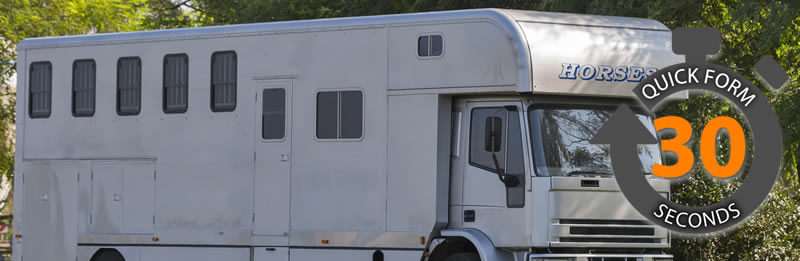










Why Compare Ford Horsebox Insurance?
Transit And Cargo Price Differently
A 3.5t Transit box and a 7.5t Cargo build can suit different providers. Comparing both ends helps the quote reflect the real plated weight, not a blanket rating.
Older Boxes Need Exact Details
Age, condition and Iveco Ford badging can all affect acceptance. Matching the V5C make, body type and weight on the form helps avoid problems at claim time.
Agreed Value Protects The Build
A coachbuilt body on an older Ford chassis may be worth more than a market valuation suggests. Clean Green Cars introduces you to UK insurance providers offering horsebox cover, so you can see agreed value options for a Cargo or Transit box in one short form.
Ford Horsebox Insurance At A Glance
- Mostly Older Used Stock - Ford horseboxes on UK roads today are mostly older vehicles bought second hand. Each one is a two-stage build, with a coachbuilder fitting the stalls, groom area and body onto a Ford chassis.
- Ford Cargo At 7.5t And 10t - The Ford Cargo was a base for UK coachbuilt horseboxes. George Smith Horseboxes says it built mostly on 7.5-ton Cargos, and JSW Horseboxes built a 10-ton Cargo box for West Yorkshire Police in 1982.
- Iveco Ford Badging - Later Cargos carried Iveco Ford badges, such as the 7.5 tonne Iveco Ford TL750. The Ford name was dropped when Iveco replaced the Cargo with the Eurocargo, so quote the make exactly as the V5C shows it.
- Transit Boxes At 3.5t - Ford Transit horseboxes turn up on the used market at 3.5t, such as a two-stall 2006 Transit listed by one dealer. A car licence covers a petrol or diesel box at that weight, but check the payload, as that listing quotes a certified 1,200kg.
- Plated Weight Sets The Licence - The maximum authorised mass on the V5C and chassis plate decides whether you need category B, C1 or C. A 7.5t Cargo needs C1, and a 10t Cargo needs C.
- Compare Quotes - see UK insurance providers for your Ford model, plated weight and use. Start with the horsebox insurance hub for guidance on every type of box.

Is Insurance Required For A Ford Horsebox?
Yes. You need at least third party insurance to use a Ford horsebox on a road or other public place, whether it's a 3.5t Transit box or a 7.5t Cargo. Driving uninsured can mean a £300 fixed penalty and 6 penalty points (an IN10 endorsement), and police can seize the vehicle.
- Road Use Needs Cover - Under the Road Traffic Act, third party cover is the legal minimum for any horsebox on the road. If the case goes to court, the fine is unlimited and you could be disqualified.
- SORN Means No Legal Need - A Ford horsebox kept off the road and declared SORN does not need insurance by law. If an older Cargo box sits in the yard over winter, laid-up cover for fire and theft can still be worth keeping.
- V5C Must Match The Build - After a conversion you must tell DVLA so the V5C body type matches the vehicle. DVLA decides the description and may inspect it, so give your insurer the same details the V5C shows.
- Older Boxes Can Carry Conditions - Some providers may ask about condition, storage or security before covering an older Cargo or Transit box, so have those details ready when you quote.
Ford Horsebox Licence Requirements
DEFRA Welfare In Transit Essentials
Your licence gets the Ford on the road. The welfare-in-transport rules decide whether a paid or professional journey is lawful. Here's what applies before a longer trip in a Cargo or Transit box, and what doesn't.
Type 1 Or Type 2 Transporter Authorisation
If you move horses more than 65km (about 40 miles) in connection with an economic activity, you need APHA transporter authorisation: type 1 for journeys up to 8 hours, type 2 for longer ones. Moving your own horse purely for leisure is outside these rules, but professional riders are inside them, whether the box is a Transit or a Cargo.
Journey Log And APHA Submission
Journey logs are only for unregistered horses travelling from Great Britain to another country on a journey of more than 8 hours. Section 1 goes to APHA at least 2 working days before you travel, and the completed log is returned within one month. A trip that stays inside the UK doesn't need one.
Registered Horse Exemption
A horse counts as registered if it's in an EU-recognised studbook or entered with a national branch of an international racing or competition organisation. They're exempt from journey logs and the journey-time, rest and feeding rules. In-scope transporters still need authorisation and an animal transport certificate, and every horse needs its passport with it.
Cover Levels Explained
Pick third party only on a converted Ford and a fire or theft could leave you paying for the whole loss yourself. Here's what each level usually includes.
| Feature | Comprehensive | Third Party, Fire & Theft | Third Party Only |
|---|---|---|---|
| Liability to third parties (legal minimum) | Yes | Yes | Yes |
| Fire and theft of the Ford horsebox | Yes | Yes | No |
| Accidental damage to the Ford cab and coachbuilt body | Yes | No | No |
| Tack and personal effects in transit | Often included up to a limit | Provider-dependent | No |
| Agreed value on an older Cargo or Transit conversion | Often available | Provider-dependent | No |
| Custodial liability (care, custody and control of other horses) | Often add-on | Add-on | No |
| Public liability for livery or eventing use | Often included or add-on | Provider-dependent | No |
| European Union driving cover | Yes (period-limited) | Yes (period-limited) | Yes (period-limited) |
| Breakdown with heavy-vehicle recovery (7.5t and 10t Cargo) | Often add-on | Add-on | Add-on |
| Horse-onward-care or livery during breakdown | Often add-on | Provider-dependent | No |
| Personal accident benefit for driver and passenger | Typically yes | Provider-dependent | No |
Features, benefits, terms and conditions vary from one insurance provider to another, so always check the policy wording.
Cover Tip: On an older Cargo or Transit box the chassis may be worth little on its own. The coachbuilt body, partitions, ramp and fitted contents carry most of the value, and usually only comprehensive responds to damage to those. Agreed value, tack in transit and custodial liability (also called care, custody and control, the cover for a horse on board that you don't own) are worth comparing on each quote.
What May Not Be Covered
A wrong plated weight or an undeclared change of use can turn a Ford horsebox claim into a refused one. Here's what a standard Ford horsebox policy may not cover.
Standard Exclusions
- V5C That Doesn't Match The Build - Cover may be refused if the V5C, the quote and the vehicle tell different stories. After a conversion you must update the body type with DVLA, and on an Iveco Ford Cargo the make you declare should match the one the V5C shows.
- Undeclared Coachbuilder Or Conversion - Changes since the original build, such as a living area, extra stalls, a new floor or ramp, or a full rebuild of an older Cargo body, may invalidate cover if they haven't been declared. List every change and name the coachbuilder where you know it.
- Driving Outside Licence Entitlement - Driving a 7.5t Cargo box on a car licence alone, without C1 or pre-1997 rights, is outside your entitlement and may invalidate the policy. A 10t Cargo needs a full category C licence, and a Transit box plated above 3,500kg needs C1.
- Undeclared Hire And Reward - Carrying other people's horses for payment, a fuel contribution or prize money while rated on social, domestic and pleasure use is usually excluded. DVSA treats indirect payment and prize money as commercial, and commercial use over 3,500kg usually needs an operator licence too.
Important Limitations
- Weight Changes Without Re-Plating - Uprating a 3.5t Transit box, or downplating a heavier Cargo to 7,500kg so a C1 driver can take it, without telling your insurer may invalidate cover. Update the V5C weight and declare the plated weight shown on the V5C and chassis plate.
- Storage Or Security Breach - Some providers set storage or security conditions on higher-value boxes, such as a locked yard or an approved immobiliser. Missing a stated condition can lead to a theft or vandalism claim being refused, even if the rest of the policy is in order.
Extras Worth Considering
Skip heavy-vehicle breakdown on a 7.5t Cargo box and a roadside fault could leave your horses waiting for hours. These optional extras may be worth adding to a Ford horsebox policy.
If you take a Ford box to events on the continent, extended European cover at comprehensive level, rather than the basic third party minimum, may be worth adding. Taking horses to the EU also needs an export health certificate, which sits outside your insurance.
Standard car-style recovery usually can't lift or tow a 7.5t or 10t Cargo horsebox. A heavy-vehicle breakdown add-on with horse onward-care or temporary livery, if the box can't be fixed at the roadside, may stop a fault becoming a welfare problem.
On an older Cargo or Transit box, a market valuation may not reflect the coachbuilt body, partitions or living area. Agreed value fixes the payout figure with the provider when the policy starts, so keep photos and receipts for any rebuild or refit.
Saddles, bridles, rugs and show kit in the locker, plus liability for horses you don't own (livery clients, a friend's horse, a pupil's pony), may not be fully covered under a base policy. A tack-in-transit and custodial extension can raise the limits to realistic horsebox values.
What Affects The Cost?
Declared value, age and condition, plated weight, your licence and experience, and where the box is kept overnight tend to move a Ford horsebox quote the most. Here's how each one plays out.
| Key Factor | Impact on your price |
|---|---|
| Declared vehicle value | Ford horseboxes are mostly older used stock, so values vary widely with the body, condition and fit-out. Quotes tend to follow the declared value more closely than the age of the chassis or the engine size. |
| Base chassis tier | A 3.5t Transit box usually prices differently from a 7.5t Cargo build of similar condition, partly because the lighter vehicle sits inside the car licence and suits a wider range of drivers. |
| Maximum Authorised Mass (MAM) | The price can change at each weight step, from a 3.5t Transit, through a 7.5t Cargo or Iveco Ford Cargo, to a 10t Cargo, with heavier boxes generally pricing above the lighter end of the range. |
| Use type | Social, domestic and pleasure use typically prices lowest, business equestrian use (livery, eventing, teaching) sits in the middle, and carrying other people's horses for payment prices highest on a Ford horsebox. |
| Driver age and licence history | Drivers with a long clean licence, the category the plate needs (C1 for a 7.5t Cargo, C for a 10t one) and horsebox experience tend to price lowest. Younger drivers, or anyone without that category, may find fewer quotes. |
| Claims and conviction history | A clean five-year claims record on any motor policy typically prices below a record with fault claims. Recent motoring convictions, even ones picked up in a car, can also push a Ford horsebox quote up. |
| Overnight storage | A locked yard or CCTV-covered compound typically prices lowest, a locked driveway or barn sits in the middle, and parking on the street often prices highest for a Transit or Cargo box. |
| Annual mileage | Leisure boxes often cover modest mileage, while commercial use may run much higher. Declaring a realistic figure rather than a car-style guess tends to price more accurately on a Ford horsebox. |
| Age and condition | An older Cargo or Transit box with a sound floor, ramp and partitions, plus a current MOT or HGV annual test, may be easier to place than one with a patchy history or a long list of repairs. |
| Security devices fitted | A Thatcham-approved alarm, immobiliser, tracker or wheel lock may help the quote on an older Ford box, and some providers require approved security on higher-value or agreed-value builds. |
The quotes you get will depend on your own details.
Price Insight: Most Ford horseboxes for sale are older stock. Commercial Motor reported in January 2004 that Iveco had replaced the Cargo with the Eurocargo and dropped the Ford name, so a Cargo chassis is likely to be over 20 years old. Prices tend to follow declared value, plated weight and use rather than the Ford badge, and an honest agreed value on a well-kept older box tends to matter more than its age alone.

Ways To Help Reduce Your Premium
Renew without checking and a Ford horsebox policy can drift above what other providers would charge. Here are practical ways to help bring the price down.
Match The V5c To The Build
Check the V5C body type, make and plated weight all match the converted vehicle and your quote. An Iveco Ford Cargo may appear under either name, so declare exactly what the V5C says.
Use Locked Yard Or Secure Compound Storage
Declare a locked yard, a CCTV-covered compound or a gated farm store, accurately and only where you genuinely use it. Secure storage tends to be one of the biggest levers on a Ford horsebox quote, particularly on a higher-value Cargo build.
Fit Security To Older Boxes
Fit a Thatcham-approved alarm, immobiliser or tracker where an older Cargo or Transit box has none. It may help the quote, and some providers require approved security on higher-value or agreed-value Ford horseboxes.
Declare The Exact Plated Weight
Declare the plated weight on the V5C and chassis plate, not the weight the box was first sold at. Some heavier boxes are downplated to 7,500kg so a C1 driver can take them, and a Transit uprated above 3,500kg needs C1.
Declare Limited Mileage Where Honest
Quote the miles you really drive. An older Ford box used at weekends and in the show season may cover only a modest distance, and a limited mileage option, where the provider offers one, can bring the quote down.
Pay Annually If You Can Afford It
Pay for the year upfront if you can. It avoids the APR (the credit interest added when you pay monthly), which can quietly add a meaningful amount to a Ford horsebox policy over the year.
Quote Tip: Declaring the exact plated weight, secure storage on a locked yard, a working immobiliser or tracker, and realistic limited mileage tends to be the combination that moves a Ford horsebox quote the most. Older leisure boxes often cover few miles a year, so a car-style mileage guess can mean paying for miles you never drive.
How To Compare Quotes
Comparing Ford horsebox insurance from UK insurance providers takes only a few minutes. Get started above.
Share Your Details
Enter the Ford model (Transit, Cargo or Iveco Ford Cargo), the year, the coachbuilder if you know it, the plated weight, declared value and your postcode. The form takes a few minutes.
Confirm Body Classification
Check the V5C body type reflects the conversion, then declare any uprating or downplating, fitted living area, rebuilt floor or ramp, or other work done since the box was first built.
Compare Cover Levels
Look at third party fire and theft and comprehensive side by side, then read the tack-in-transit, custodial liability and agreed value wording on each option for your Transit or Cargo box.
Weigh Add-Ons
Decide on European cover, heavy-vehicle breakdown with horse onward-care, agreed value and custodial liability based on the plated weight, declared value and whether other people's horses ever travel.
Set Inception Date
Choose the day your cover should start. The provider issues your certificate and your Motor Insurance Database (MID) record once payment is complete.
What Our Expert Says
Ford horseboxes are mostly older vehicles now. You're usually looking at a coachbuilt Cargo, often at 7.5t, or a 3.5t Transit box bought second hand. Because the Cargo name ended with Iveco's Eurocargo, condition, payload and value need more care than on a newer box.
The common trap is use. A box rated for social, domestic and pleasure use starts carrying a friend's horse, the friend chips in for diesel, and the trip is no longer private. DVSA counts indirect payment and prize money as commercial, so quote on the use that matches every horse the box carries and whether any money changes hands.
The other check is the paperwork. An Iveco Ford Cargo can be listed under either name, and a Transit box may have been re-plated since it was built. Make sure the make, model and plated weight on your quote match the V5C and chassis plate, and that the V5C body type reflects the conversion. When those line up, the licence, the annual test and the quote all point the same way.
Insurance Expert & Co-founder of Clean Green Cars
Common Questions
Do I Need C1 To Drive A Ford Cargo Horsebox?
Usually yes. Most Cargo and Iveco Ford Cargo horseboxes are plated at 7.5t, which falls in category C1 (3,500kg to 7,500kg). Drivers who passed their car test before 1 January 1997 usually have C1 already, so check your entitlement online. If you passed on or after that date, you need to add C1, which means a theory test plus off-road and on-road practical tests. A 10t Cargo needs a full category C licence.
Can I Drive A Ford Transit Horsebox On A Car Licence?
Yes, if it's plated at 3,500kg or less. A car licence (category B) covers a petrol or diesel horsebox up to 3,500kg MAM, which is where the used Transit boxes in UK listings sit. Ford sells Transit chassis cabs up to 5 tonnes, though, so check the plate before you buy. A box plated above 3,500kg needs C1 and takes the HGV annual test instead of a car-style MOT.
Does A Transit Horsebox Cost Less To Insure Than A Cargo?
Often, but not always. A 3.5t Transit box sits inside the car licence, suits a wider range of drivers and may carry a lower declared value than a 7.5t Cargo build. The gap can narrow if the Cargo is on private use only, kept on a locked yard and driven by an experienced C1 holder with a clean record.
Is An Iveco Ford Cargo The Same As A Ford Cargo?
Broadly, yes. The Iveco Ford Cargo is the Cargo after Iveco took over the range, often seen as a 7.5 tonne model such as the TL750. Iveco later replaced it with the Eurocargo and dropped the Ford name, so it isn't the same vehicle as a current Eurocargo. For insurance, quote the make and model exactly as your V5C shows them.
What's Custodial Liability On A Horsebox Policy?
It's cover for a horse you're carrying but don't own. Custodial liability, sometimes called care, custody and control, covers your legal liability for that horse while it's in your care. It tends to matter if you take a friend's horse to a show, move livery clients' horses or ship a pupil's pony, even now and then. It's usually an add-on rather than standard.
Does A Ford Cargo Horsebox Need HGV-Rated Breakdown Cover?
Usually yes. Standard car-style recovery often can't lift or tow a 7.5t or 10t Cargo box, and heavy-vehicle breakdown with horse onward-care may stop a roadside fault becoming a welfare problem. A 3.5t Transit box is lighter, though horsebox-specific recovery still tends to suit it better because the horses need moving too.
Do I Need DEFRA Transporter Authorisation For My Ford Horsebox?
Only if your journeys are linked to an economic activity and go over 65km (about 40 miles). Moving your own horse purely for leisure is outside these rules. Professional riders, liveries and anyone paid to move horses are inside them, and need APHA type 1 authorisation for journeys up to 8 hours or type 2 for longer ones, plus a certificate of competence, on top of the insurance.
What Happens After I Submit My Details?
Clean Green Cars introduces you to UK insurance providers or regulated brokers that offer horsebox cover for your Ford model, plated weight, use and storage. Quotes usually appear within minutes and can compare cover, price and add-ons before choosing a policy that suits your Transit or Cargo box and the way you actually use it.

Search & Compare Quotes From UK Ford Horsebox Insurance Providers

Useful Resources
- GOV.UK - Driving Licence Categories - the official table of UK licence categories, showing the weights B, C1 and C cover for a 3.5t Transit box, a 7.5t Cargo or a 10t Cargo.
- GOV.UK - Change Vehicle Details On A V5C - how to update the body type or weight on your V5C after a conversion or re-plating, and when DVLA may inspect the vehicle.
- GOV.UK / DEFRA - Transporting Animals In Great Britain - the official guidance on type 1 and type 2 transporter authorisation, certificates of competence and vehicle approval for horse journeys over 65km.
- GOV.UK - MOT For HGVs, Buses And Trailers - the annual test that horseboxes over 3,500kg take, including older 7.5t and 10t Cargo boxes.
- DVSA - Transporting Horses In Horseboxes And Trailers - DVSA's guidance for horsebox owners on licences, operator licences, tachographs and what counts as commercial use.
- GOV.UK - Horse Passports - the rules on keeping a valid passport with your horse at all times, including when it travels in your horsebox.