
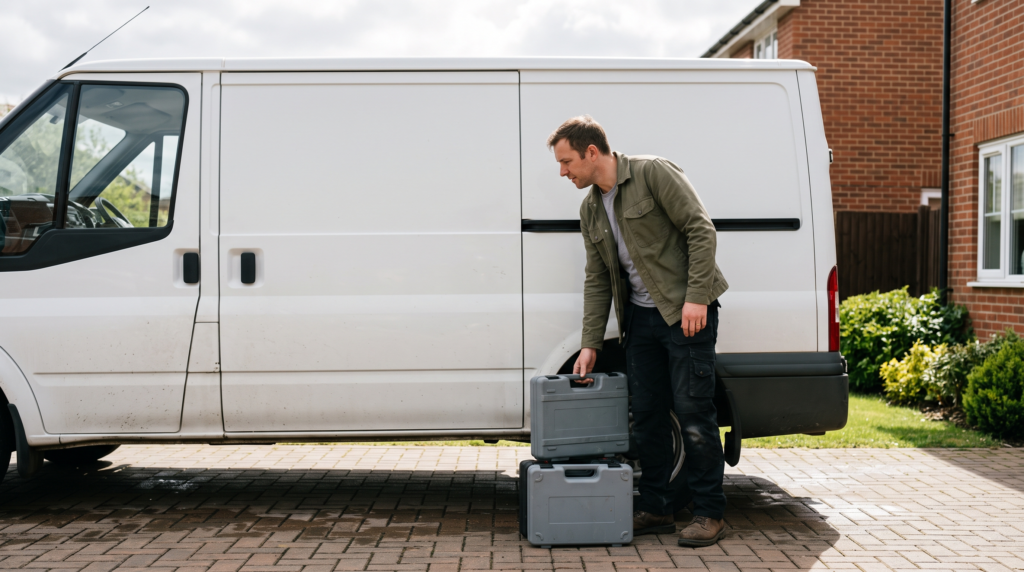
Why Van Insurance Often Costs More Than Car Insurance
It often does, but the gap usually comes from how the van is used, not from the van itself.
The basics are the same for both. You must have motor insurance to drive a van or a car on UK roads, and third party cover is the legal minimum for either. Most vans can also be driven on an ordinary car licence.
So the difference sits in the details an insurer prices. A van is more likely to be used for work, carry tools or goods, cover more ground and be driven by more than one person. Each of those can push a quote up.
Van Vs Car Insurance: What's The Same And What's Different
Fewer things differ than you might think. The table shows where van and car insurance match and where a van quote tends to move.
Van Vs Car Insurance At A Glance
What stays the same, and where a van quote tends to move.
| Car insurancePriced on the car and drivers | Van insurancePriced on the van, drivers and the work | |
|---|---|---|
| Legal minimum | Third party | Third party |
| Licence | Car licence | Car licence up to 3,500kg, or 4,250kg electric |
| Insurance group | Group Rating 1 to 50 | Group Rating 21 to 50 |
| Typical use | Social and commuting | Often work, tools or goods |
| Tools and goods | Rarely part of the quote | Often an add-on or separate cover |
| Drivers | Often one or two named | May be shared by a team |
A guide to what to check, not advice. Prices and terms vary between insurers.
The legal minimum and the licence are set by law, and the group range by how vehicles are rated. The rest is where your own answers on the quote form do the work.
How You Use The Van Usually Makes The Biggest Difference
Usually, yes. The class of use (what the policy lets you use the van for) is often the single biggest step in a van quote.
The common classes run from social, domestic and pleasure, to commuting, to business use for carrying your own tools and goods. Getting paid to deliver other people's goods is hire and reward, which is a separate use again.
Each step adds time on the road and more to insure, so the price may rise at each one. Pick the class that matches what you really do. If the use on your policy doesn't match your work, an insurer may decline a claim.
What The Van Itself Adds To The Price
A van starts higher up the insurance group scale than a car. Thatcham Research gives cars and light commercial vehicles (the industry term that covers vans) a Group Rating score that insurers use to help judge a vehicle's risk.
Car scores run from 1 to 50. Van scores run from 21 to 50, and a higher score points to a higher insurance risk. So no van sits in groups 1 to 20, which only cars can have.
The score looks at the cost and time to repair the vehicle after a claim, its new price, its performance and weight, and its standard security and safety kit. Racking, conversions and signwriting aren't in that score, so tell your insurer about them too.
Electric vans need a quick licence check as well. GOV.UK's driving licence categories let a car licence cover electric vans up to 4,250kg, against 3,500kg for petrol and diesel. If you're weighing one up, see what to check before insuring an electric van.
Tools, Goods And Extra Drivers Aren't In A Car Quote
Not usually. These are the extras a car quote rarely has to think about, and they're often where a van quote grows.
A van policy covers the van. Tools, stock and goods you carry usually need an add-on or separate cover, so a van quote with tool cover isn't comparing like for like with a car quote.
Extra drivers matter too. A van shared by a team, or open to any driver, is priced on more people than a car with one or two named drivers.
When A Van Quote Can Be Closer To A Car Quote
It can be. A van used for social trips and commuting, with a small number of experienced named drivers, may be priced much closer to a similar car.
Your driving history, where the van is kept overnight and the security you really use all still count. Declare them accurately rather than guessing to get a lower figure.
Ian's note: When you hold a van quote up against your car price, check the two are like for like. A social-only van quote can look close to your car price, but it won't cover driving for work.
If you need cover for work, tools or goods, look at van insurance built around how you use the van. You can compare van insurance quotes when you're ready.
FAQs
Can van insurance cost less than car insurance?
Sometimes. A small van used only for social trips, with experienced named drivers, may cost about the same as a similar car or less. Add business use, goods or extra drivers and the price usually rises.
Can I use my car no-claims bonus on van insurance?
It depends on the insurer. Some may accept a car no-claims bonus on a van policy, others may give part of it or none. Ask before you buy and have proof of your no-claims history ready.
Do vans have insurance groups like cars?
Yes. Thatcham Research gives vans a Group Rating score, just as it does for cars. Van scores run from 21 to 50 and car scores from 1 to 50. The score looks at repair costs, the new price, performance and security.
Can I drive a van on a car licence?
Yes, if the van is within the weight limit. GOV.UK says a car licence, if you passed your test on or after 1 January 1997, covers vehicles up to 3,500kg, or 4,250kg if electric or hydrogen. You still need insurance that covers the van and how you use it.
Is there VAT on van insurance?
No. Insurance is exempt from VAT, so there's no VAT to reclaim on a van policy. Insurance Premium Tax, a tax on insurance premiums, applies instead. The guide on why car insurance costs what it does explains what goes into a premium.
Does van insurance cover my tools?
Not automatically. A standard van policy covers the van itself. Tools, stock and goods you carry often need an add-on or separate cover, so check the policy details before you rely on it.