Your Policy Responds, Not Uber's
The private hire insurance on the car deals with a crash on an Uber trip, not Uber. That may be your own policy, or one your operator or fleet holds. Uber says it doesn't underwrite insurance or decide the premium, cover, eligibility or claims outcome.
So claims from other people for injury or damage go through the car's motor insurer. Whether damage to your own car is covered depends on your level of cover.
That's why Uber checks your cover before you can drive. Uber says your policy must include hire and reward cover (being paid to carry passengers) and meet your licensing authority's requirements. TfL says every PHV must have that insurance whenever it's being used as a PHV. You can read more about insurance for Uber drivers.
Uber does offer Partner Protection, but it covers you personally, not the car. There's more on that below.
After a crash on a trip, the order usually runs like this: the scene, your passenger, Uber, your insurer, then TfL or your council if you own the car. Each step is covered here in turn.
At The Scene: What The Law Says You Must Do
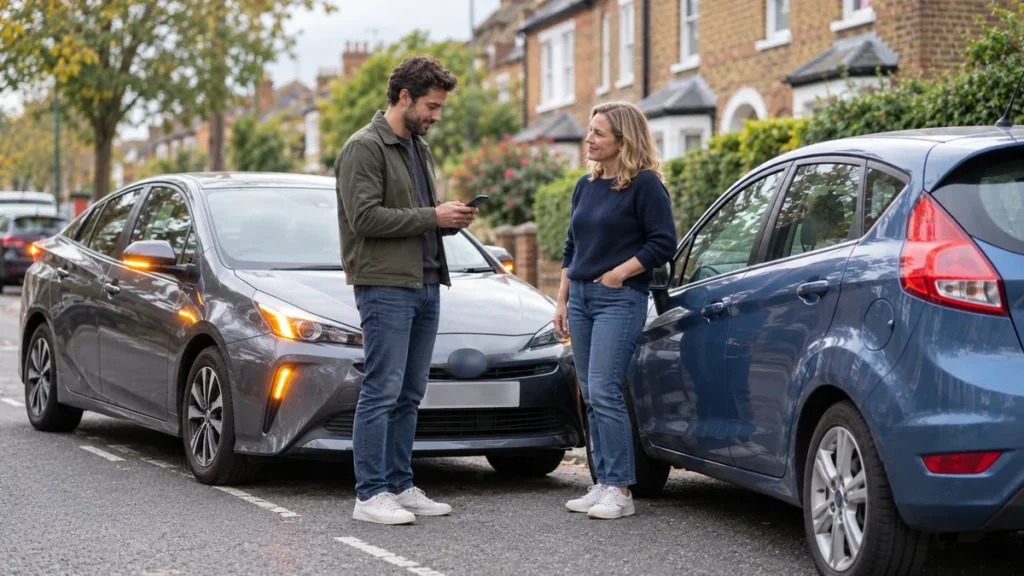
Stop somewhere as safe as you can, put your hazard lights on and check whether anyone is hurt. Call 999 if they are, then give your details to anyone with reasonable grounds to ask.
Under the Highway Code's rules on collisions, you must stop if a collision causes damage or injury. You must then give your own name and address, the vehicle owner's name and address and the registration number.
On a trip, the owner may not be you. If you rent the car or drive one from a fleet, keep the owner's name and address with your documents so you're not searching for it at the roadside.
If you don't give your name and address at the scene, the Highway Code says you must report the collision to the police. Do it as soon as reasonably practicable, and within 24 hours at the latest.
Injury adds one more step. If someone else is hurt, the police or anyone with reasonable grounds may ask to see your insurance certificate at the scene. If you don't show it to them, you must report it to the police as soon as possible and within 24 hours. You must then produce the certificate for the police within seven days.
After A Crash On An Uber Trip: Your Checklist
What the law, TfL and Uber ask of you, in the order you'll need it.
At The Scene
- Stop if the collision caused damage or injury
- Give your name and address, the owner's name and address and the registration to anyone with reasonable grounds to ask
- Give your insurance details to your passenger or any member of the public involved
Within 24 Hours
- If you didn't give your name and address at the scene, report the collision to the police
- If someone was injured and you didn't show your insurance certificate, report it to the police, then produce the certificate within seven days
Tell The People Who Need To Know
- Your insurer, even if you're not planning to claim
- Uber Support or a Greenlight Hub, however minor the accident
- TfL within 72 hours if you own the car and the damage affects its safety, performance, appearance or comfort
- Your council within 72 hours if it licenses the car and the damage materially affects it
Before Your Next Trip
- Check whether TfL needs to re-examine the car before more private hire work
- Upload any new insurance certificate or cover note to Uber
A summary of the rules, not legal advice. Your licensing authority's own conditions also apply.
Give Your Insurance Details To Passengers
Yes, your passenger is entitled to them, and so is any member of the public involved. TfL's private hire driver handbook says you must give insurance details to the police when they ask. It also says you must give them to a passenger or member of the public if the car you're driving is in a collision.
That's TfL's rule for London private hire drivers. If you're licensed elsewhere, the Highway Code duties to stop and give details still apply, and it's worth checking your own licence conditions.
Keep it simple at the roadside. Your insurer's name and policy number from your certificate or cover note are usually what people need. Do not argue about who was at fault. Leave that for the insurers to work through.
Tell Uber, However Minor It Was
Yes, Uber's community guidelines say every accident and injury should be reported. They say all accidents and injuries, however minor, should go to the Uber Support team or a Greenlight Hub. That includes a scuffed bumper with nobody hurt.
The guidelines also say you must cooperate with Uber on health and safety matters, including the investigation of any incident. Uber says it reviews reports of crashes and potentially unsafe driving.
Uber may, at its sole discretion, put a hold on your account or make it inactive until its review is complete. That isn't automatic, but it can be hard when the app is how you earn. Answer Uber's questions promptly, and keep your photos and notes from the scene together.
Tell Your Insurer, Even If You Won't Claim
Yes, GOV.UK says you must report the accident to your insurer even if you're not planning to claim. GOV.UK's guidance on reporting an accident puts it plainly, so a minor knock on a trip still needs a call.
The private hire policy on the car, whether it's yours or your operator's or fleet's, is the compulsory motor insurance. It's the one that deals with claims from other people. By law, that insurance has to cover your liability if using the car on the road injures anyone, passengers included, or damages property.
The legal minimum doesn't have to cover damage to the car you're driving, so check your own policy for that. You can read what compulsory motor insurance must cover on legislation.gov.uk.
How the insurer then handles any claim depends on the policy wording and what happened. Partner Protection doesn't change that. Uber says it isn't commercial motor insurance and isn't a substitute for your compulsory motor insurance.
Your Private Hire Policy Vs Uber's Partner Protection
Two different things that drivers often mix up after a crash.
| The car's private hire policyThe compulsory motor insurance on the car | Partner ProtectionUber's cover for you as a driver | |
|---|---|---|
| What it is | Motor insurance that must cover hire and reward use | Not motor insurance and not a substitute for it |
| What it covers | Liability for injury to anyone, or damage to property, from using the car on the road | You: medical expenses, injuries, hospitalisation, permanent disability and death |
| When it applies | Whenever the car is used as a private hire vehicle | From accepting a trip until 15 minutes after it's completed |
| If you can't work | Check your own policy wording | For eligible drivers, a daily payment for up to 30 days while a doctor certifies you unfit, after an on-trip accident |
Uber says it doesn't underwrite insurance or decide the premium, cover, eligibility or claims outcome.
If You're Hurt: What Uber's Partner Protection Covers
It covers you personally on a trip, not the car or anyone else. Uber says it protects eligible drivers on its own terms, so check you qualify and read the current terms. Uber says on-trip cover runs from the moment you accept a trip until it's completed, and for 15 minutes after.
Uber says the cover includes medical expenses, death, permanent disability, hospitalisation and injuries. If an on-trip accident leaves you unable to work, Uber says eligible drivers can get a daily payment for up to 30 days. That runs while a doctor certifies you as unfit to work, subject to the Partner Protection terms.
Anything to do with the car itself goes back to the motor policy on the car and its terms.
Ian's note: Even for a scuffed bumper with no one hurt, make the calls the same day: your insurer, Uber, and TfL or your council if you own the car. A short report now is far easier than explaining a late one.
Telling TfL Or Your Council, Then Getting Back On The Road
If you own the car and the crash affects it, report it within 72 hours. TfL's handbook says that if you own your PHV, you must tell TfL within 72 hours of any collision that affects the vehicle's safety, performance, appearance or comfort. The car may then need re-examining before you use it for private hire again.
That's TfL Taxi and Private Hire, the regulator many drivers still search for as the PCO.
If a council licenses the car, the law says the owner must report an accident to the council as soon as reasonably practicable, and within 72 hours. That applies to damage that materially affects the car's safety, performance or appearance, or passengers' comfort. You can read the law on reporting licensed vehicle accidents on legislation.gov.uk.
Councils run their own reporting process. Salford City Council, for example, says failing to report within 72 hours may lead to penalty points or referral to its Licensing Regulatory Panel. Check how your own council wants it reported.
If the crash means a new car or a new policy, Uber asks you to upload a current insurance certificate or temporary cover note. If a document bounces back, here's why Uber won't accept your insurance. For the cover you need to have in place before you drive, see the cover you need for taxi and private hire work.
If you need a new private hire policy after the crash, you can look at your options in your own time. You can compare Uber driver insurance quotes when you're ready.
FAQs
Does Uber Pay If You Get In An Accident?
Not for the car. Uber says it doesn't underwrite insurance or decide claims, so other people's injury or damage claims go through the car's private hire policy. Partner Protection covers you personally on a trip and isn't motor insurance.
Can You Still Drive For Uber After An Accident?
Not always straight away. Uber reviews crash reports and may, at its sole discretion, put your account on hold until its review is complete. You must cooperate with any investigation. If your car or policy changes, upload the new certificate or cover note.
What Happens If An Uber Driver Gets In An Accident With A Passenger?
Your passenger gets your insurance details. TfL says you must give them to a passenger or member of the public after a collision. By law, compulsory motor insurance must cover liability for injuring anyone, passengers included. Report it to Uber, however minor.
Can You Drive Uber With A Damaged Car?
Not always. If you own a TfL-licensed car, tell TfL within 72 hours of a collision affecting its safety, performance, appearance or comfort. It may need re-examining before more private hire work. Council-licensed cars carry a similar 72-hour reporting duty for owners.
Is Partner Protection The Same As Private Hire Insurance?
No. Uber says Partner Protection isn't commercial motor insurance and isn't a substitute for your compulsory motor insurance. It covers you personally from accepting a trip until 15 minutes after it ends, while the car's private hire policy covers liability on the road.