Which Cover Does Your Taxi Work Need?
Motor insurance that covers carrying paying passengers for the licence you hold, private or public hire, with you named as a driver. Ordinary car insurance doesn't do that job, and neither does the protection an app gives you.
What changes from driver to driver is the kind of hire. Rank work, street hails, app jobs and pre-booked chauffeur runs each sit under a licence, and the policy has to match that licence. Find your work in the table, then follow the route to the page that goes into it properly.
Which Cover Does Your Taxi Work Need?
Find the work you do, then check what the policy has to cover and where to read more.
| What the policy must coverThe use and licence the certificate has to match | Where to go nextThe page that covers it in depth | |
|---|---|---|
| Private hire or minicab (pre-booked only) | Private hire use for paying passengers, matched to your TfL or council licence, with you as the named driver | Private hire insurance (linked below the table) |
| Hackney carriage or public hire (ranks and street hails) | Public hire use, because passengers can hail you or pick you up at a rank as well as pre-book | Public hire taxi insurance (linked below the table) |
| Uber, Bolt or other app work | Private hire insurance that covers hire and reward and meets your licensing authority's rules. In London, it must come from a provider Uber accepts | Insurance for Uber drivers (linked below the table) |
| Chauffeur work | Cover for carrying paying passengers on pre-booked jobs, matched to how your vehicle and you are licensed | Chauffeur insurance (linked below the table) |
| Occasional or part-time driving | The same hire and reward cover for the licence you hold, for the periods you work and any minimum your council sets | Annual Or Pay As You Go, further down this guide |
A guide to what to check, not advice. Licensing conditions vary between TfL and each council, and policy terms vary between insurers.
Once you know which licence you hold, you can compare taxi insurance for that kind of work.
Where each row goes next:
- Pre-booked minicab and private hire work: private hire and minicab insurance.
- Rank work and street hails in a hackney carriage: hackney carriage and black cab insurance.
- Uber, Bolt and other app work: insurance for Uber drivers.
- Weddings, airport runs and corporate bookings: chauffeur and executive car insurance.
- Occasional or part-time shifts: see Annual Or Pay As You Go, further down this guide.
The licensing rules in this guide are for England. In London, TfL licenses drivers and private hire vehicles. Everywhere else in England, it's the local council, and each council can add its own conditions on top of the law.
Why Ordinary Car Insurance Won't Do
No. A standard car policy is built around your own driving, and carrying paying passengers needs the hire or reward cover that TfL and Uber both ask for.
MoneyHelper's guide to car insurance fibs says social, domestic and pleasure use only covers trips like visiting friends or going to the shops. Most private car policies start from that kind of use, sometimes with commuting or business use added on. Taking fares is a different use again, and your certificate has to show it.
The people who license and dispatch you are clear about this. TfL's private hire driver handbook says every private hire vehicle must have hire or reward insurance. Uber says your policy must cover hire and reward use and meet the rules of your licensing authority.
Getting the use wrong can be expensive. If you carry a paying passenger on a policy that doesn't include hire and reward, the policy may not cover that journey, so damage to your own car may not be paid for. If the insurer still has to pay someone who was hurt or left out of pocket, section 151 of the Road Traffic Act 1988 may let it recover some or all of that money from you.
Hire and reward is a topic of its own, with questions about when it applies and what the certificate should say. The detail is in our guide to hire and reward for private hire.
Private Hire Or Hackney Carriage: Why It Changes The Policy
Because the work is different. GOV.UK's private hire operator licence guidance says a private hire vehicle can only be pre-booked, while taxis can also be hired at a rank or hailed in the street.
That one line is the test. If every job comes through a booking with an operator or an app, that's private hire work. If people can flag you down or get in at a rank, that's hackney carriage work, often called public hire, and you need the licence and the cover for it.
Insurers usually treat the two as different risks, and the certificate has to match the licence you hold. A policy written for pre-booked work may not cover you for picking up at a rank or taking a street hail. If you hold a hackney carriage licence, check the policy says public hire, not private hire.
Some drivers move from a minicab to a hackney carriage over the years, or the other way round. If your licence changes, tell your insurer before your first shift under the new one. How the two covers compare in more depth is set out in private vs public hire taxi insurance.
What The Council Or TfL Will Ask For
Proof of insurance before they license the vehicle, covering the right kind of hire with you named on it. Who does the asking depends on where you work. GOV.UK's taxi driver licence guidance says you apply to TfL to work in London and to the local council to work outside London. For private hire work, the driver, the vehicle and the operator all have to be licensed by the same council or TfL.
Outside London, councils license private hire vehicles under the private hire vehicle licensing law. In plain words, the council must be satisfied that a valid motor insurance policy is in force for the way the vehicle will be used before it grants the licence. That's why the certificate is part of the application.
GOV.UK's vehicle licence eligibility rules put it simply: you need insurance that covers you for public or private taxi hire and includes you as the named driver. So the council isn't just checking that a policy exists. It's checking the type of hire and the name on it. There's more on what councils and TfL check before licensing in a separate guide.
In London, TfL says hire or reward cover must be in place when the vehicle is licensed and whenever it's used as a private hire vehicle. TfL's notice on insurance requirements also dropped an earlier rule that London private hire vehicles had to carry hire or reward cover at all times.
You'll still hear drivers talk about the PCO. That was the Public Carriage Office, the old name for TfL's Taxi and Private Hire department, and TfL's private hire operator handbook says the name is no longer in use.
The old name stuck, which is why so many drivers still search for PCO cover. If you've been quoted under that name, there's a short explainer on what PCO insurance means.
Driving For Uber, Bolt And Other Apps
You still need your own private hire insurance. The app checks your cover, but it doesn't provide motor insurance for you.
Uber says drivers need valid private hire insurance that covers hire and reward use and meets their licensing authority's requirements. If TfL licenses you, Uber's London insurance requirements say the policy must come from a provider Uber accepts in London that's linked to its Instadoc checks. For the full checklist, see what insurance Uber requires.
That second rule catches drivers out. A policy can be valid for private hire work and still not be one Uber accepts in London, so check before you buy, not after the upload fails.
Partner Protection is the other thing drivers mix up. Uber's Partner Protection details say it doesn't provide commercial motor insurance and isn't a substitute for your compulsory motor insurance. Uber says eligible partners are insured by Allianz Partners while On-Trip, with cover including medical expenses and injuries. It sits alongside your motor policy, not in place of it.
Bolt and other apps run their own document checks, so read each app's requirements before you sign up. If Uber has rejected a certificate you've uploaded, here's why Uber may reject your insurance.
Cover Levels And Extras Drivers Check
The same three levels as ordinary car insurance, plus liability covers that only some drivers and operators need.
Third Party, Fire And Theft, Or Comprehensive
Third party cover is the legal minimum. The Road Traffic Act's insurance rules say it must cover your liability if someone is killed or injured because of your use of the vehicle on a road. The same goes for damage to property.
In plain words, third party covers harm to other people and their property, not damage to your own car. Third party, fire and theft adds cover if your car is stolen or damaged by fire. Comprehensive adds cover for damage to your own car as well.
When the car is how you earn, ask how long you could be off the road after a claim and whether a replacement car is included. Days without the car are days without fares.
Public Liability
No, not as a general legal rule for individual drivers. The official rules checked for this guide set no general public liability requirement on taxi or private hire drivers themselves. Where the rules are clear, they're about operators.
TfL's private hire operator handbook says a London operator whose operating centre is open to the public must hold public liability insurance. For councils in England, the DfT's licensing best practice guidance says it's appropriate for a licensing authority to check that a private hire operator has suitable public liability cover.
If you run your own small operation, or customers come to an office to book, check your council's conditions. If you just drive for an operator, ask what the operator holds and check your council's driver conditions too.
Employers' Liability
Only if you employ people. GOV.UK's employers' liability guidance says you need it as soon as you become an employer, from an authorised insurer and with a minimum level of cover. Some employers, such as those only employing a family member, don't need it. If it's just you driving your own car, it doesn't come into it.
What Affects What You Pay
Your licence type, where you work, your driving record and the vehicle usually matter most. There's no single taxi price, and there are no figures here, because prices vary by insurer and driver.
What Affects What You Pay For Taxi Cover
These are the things insurers usually look at. No figures here: prices vary by insurer and driver.
Bars show how much each factor tends to matter, not prices. Every insurer weighs factors differently.
A general list, not a price guide. Each insurer weighs these differently.
Each insurer weighs these its own way, so quotes for the same driver can differ a lot. The same driver may also be quoted differently for private hire and public hire work, because the jobs carry different risks.
Some of these levers are in your hands, such as the cover level and how you buy it. Others, like your record, only change with time. For what drivers tend to pay and why, see how much taxi insurance costs.
You can compare taxi insurance quotes when you're ready.
New Drivers, Young Drivers And Convictions
It's possible, but licensing comes first, and the council's rules can stop you before an insurer does.
New And Young Drivers
Outside London, the private hire driver licence law sets a 12-month rule. A council must not grant a private hire driver's licence to anyone who hasn't been allowed to drive a car for at least 12 months. So the insurance question only starts once you can be licensed.
After that, insurers may quote new taxi drivers, though the choice may be narrower in your first years. Age can affect the price too, as it does on ordinary car insurance. There's more on private hire insurance for new drivers.
Points And Convictions
Convictions matter at licensing as well as on the quote. The DfT's statutory taxi standards say someone with a drink or drug driving conviction shouldn't be granted a licence until at least 7 years after any sentence or ban ends. These standards are for licensing authorities in England.
For other offences, insurers may still quote drivers with points or convictions, though the price is usually higher. Tell the insurer about every conviction it asks for, exactly as it appears on your licence. The detail is in taxi insurance with a conviction.
Using The Car For Personal Trips
Only if your certificate includes social, domestic and pleasure use as well as hire and reward.
Plenty of drivers use the same car for the school run, the weekly shop and a Saturday night shift. Whether those off-shift trips are covered depends on the use your certificate lists, not on what you assume a taxi policy includes.
Some councils make it a licence condition. Winchester's private hire vehicle licence rules ask for a certificate covering the vehicle for hire and reward for private hire use and for social, domestic and pleasure purposes. Check your own council's conditions and your certificate before you rely on either.
If personal use is missing and you need it, ask your insurer whether it can be added before you take the car out off shift. Other limits can sit in the small print as well, such as who else may drive the car. See private hire insurance restrictions to check.
Annual Or Pay As You Go?
It depends how often you work. Annual cover suits full-time driving, while pay as you go may suit occasional shifts if your licensing authority accepts it.
The catch is licensing. Your council or TfL needs to see valid cover when it licenses the vehicle, and some councils set a minimum cover period. Bedford Borough Council's taxi policy says it won't accept insurance that doesn't cover at least the first calendar month of a licence period.
So before you lean on short-term cover, ask your council or TfL what it accepts at licensing. Then make sure every shift you work sits inside a period of cover that includes hire and reward.
If you only drive a few shifts a month, or you fit driving around another job, see how pay as you go taxi cover works. Then check it fits your licence.
If You Have A Crash While Working
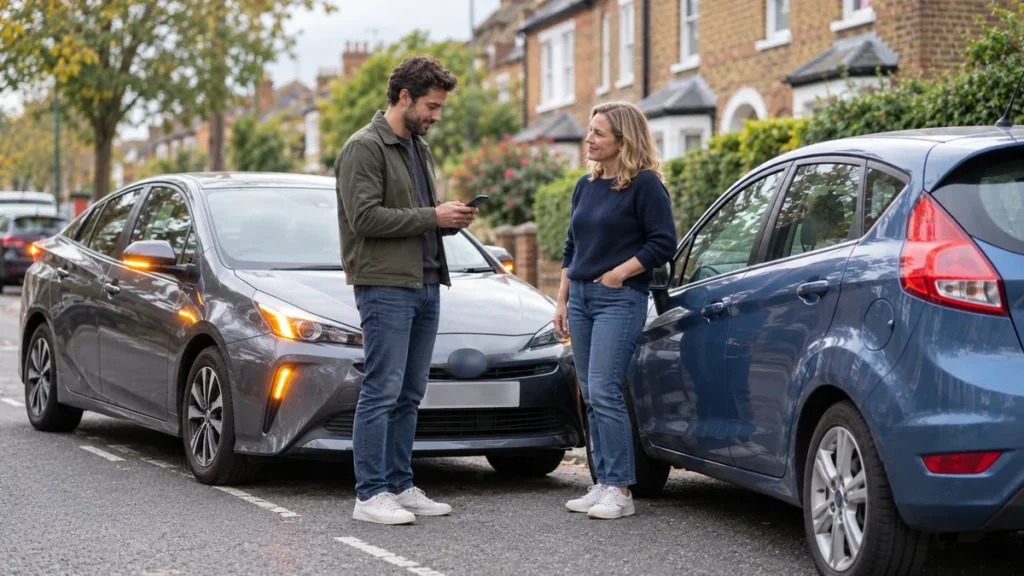
Stop, stay safe, and give your insurance details to anyone who's entitled to them.
TfL's private hire driver handbook says you must give insurance details to the police when asked. You must also give them to a passenger or member of the public if your vehicle is involved in a collision. Keep a copy of your certificate in the car or on your phone, so you're not searching for it at the roadside.
Do not admit liability at the scene. Take photos, note the time and place, and get the other driver's details and any witnesses. Tell your insurer as soon as you can, even after a minor collision at a rank. If it happened on an Uber trip, see what happens after a crash on an Uber trip.
Your policy has to cover the way you were using the car at the time. If a passenger was on board and your cover didn't include hire and reward, an insurer may decline the claim. That's the costly version of the mismatch this guide keeps coming back to.
Ian's note: Read the certificate before you send it anywhere. It should say public or private hire to match your plate, carry your name as a driver, and include personal use if you'll drive the car off shift. If your operator insures the car rather than you, keep proof that you're insured to drive it under that policy.
Before You Buy A Policy
Check the certificate matches your licence, your name and the way you'll use the car.
The wrong type of hire, a missing name or a start date after the licence check can each hold up a vehicle licence or an app account. Run through this list before you pay.
Before You Buy A Taxi Or Private Hire Policy
Check these before you pay, and before the council, TfL or an app sees the certificate.
The Certificate
- Check it covers public or private hire to match the licence you hold
- Check you're named as a driver
- Check the use line includes hire and reward for paying passengers
- Check it includes social, domestic and pleasure use if your council asks for it
Your Licensing Authority
- Check the cover starts before you apply for the vehicle licence
- Check any minimum cover period your council sets
- Know whether you're licensed by TfL or a local council
Apps And Extras
- If you drive for Uber in London, check the provider is one Uber accepts
- Decide whether you need public liability or employers' liability
- Keep insurance details to hand for passengers and the police
Your council or TfL has the final say on what it accepts.
Have your licence details, vehicle details and any claims or convictions to hand before you start, so the quotes reflect your real situation.
You can compare taxi insurance quotes when you're ready.
FAQs
Do I Need Public Liability Insurance As A Taxi Driver?
Not as a general legal rule for drivers. TfL requires London private hire operators whose operating centre is open to the public to hold it, and councils can check operators have it. Check your own council's conditions.
Can I Use My Taxi For Personal Trips?
Only if your certificate includes social, domestic and pleasure use as well as hire and reward. Some councils, such as Winchester, ask for both on the certificate. Check yours before using the car for the school run or shopping.
Does Personal Car Insurance Cover Uber Driving?
No. Uber says you need private hire insurance that covers hire and reward and meets your licensing authority's rules. Its Partner Protection isn't motor insurance. In London, your provider must also be one Uber accepts.
Do I Need Taxi Insurance When The Car Isn't Working?
Not always. In London, TfL only needs hire or reward cover when the car is licensed and whenever it's used as a private hire vehicle, though you still need ordinary motor insurance for any other road use. Outside London, check your council's conditions.
What Does Taxi Insurance Cover?
At minimum, your liability if someone is hurt or property is damaged through your use of the car on a road, while carrying paying passengers under your licence. Third party, fire and theft and comprehensive add cover for your own car.
Is PCO Insurance The Same As Private Hire Insurance?
Yes. PCO stands for the Public Carriage Office, the old name for TfL's Taxi and Private Hire department, which is no longer used. Drivers still say PCO insurance when they mean private hire insurance for a TfL-licensed car.
Do Taxi Drivers Need A Commercial Licence?
Not a commercial licence as such, but you do need a taxi or private hire driver licence from TfL or your council. TfL issues it to work in London, your local council elsewhere, and your insurance has to match it.
Can I Get Taxi Insurance As A New Driver?
Usually, once you can be licensed. Outside London, a council can't grant a private hire driver licence until you've been allowed to drive a car for at least 12 months. Insurers may then quote, though the choice may be narrower.