














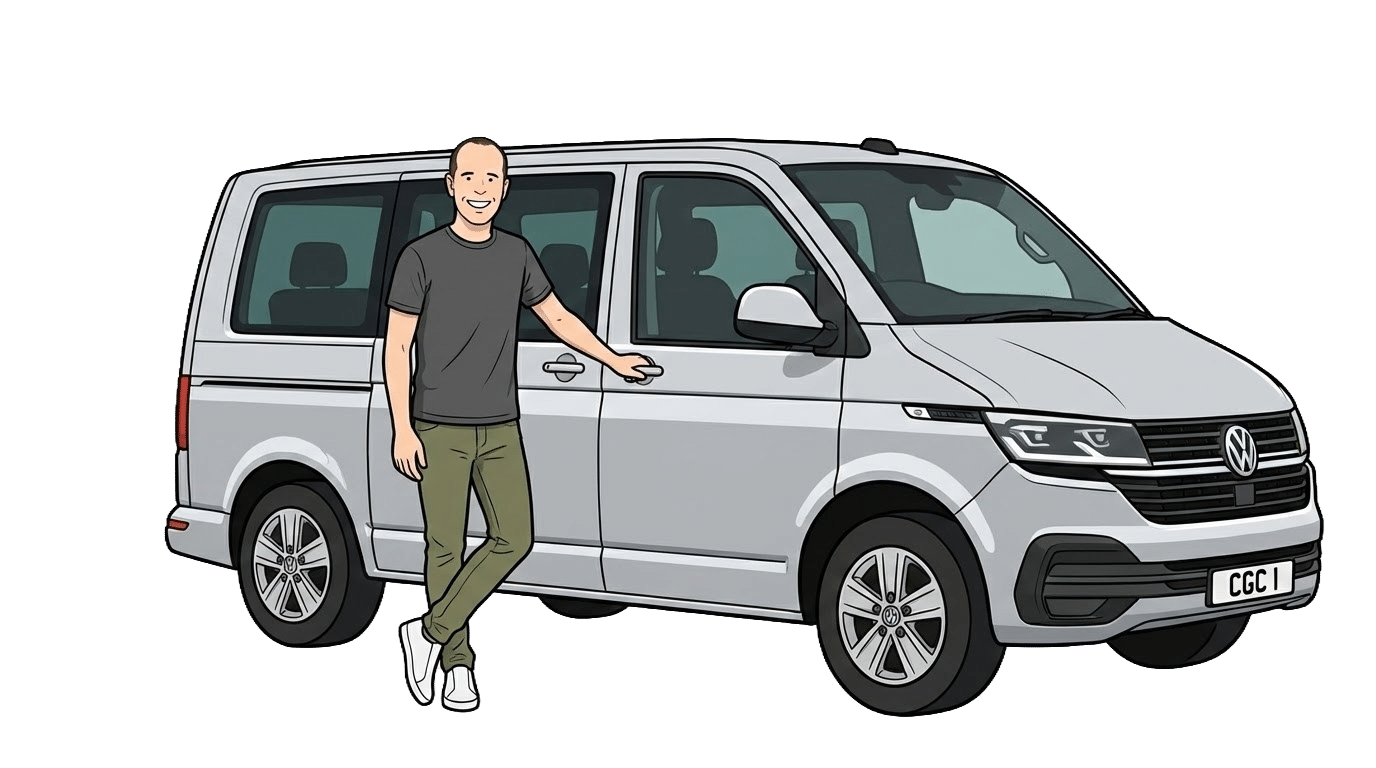
Why Compare 9-Seater Minibus Insurance?
9-Seater Minibus Insurance at a Glance
- A 9-seat vehicle is generally treated as a minibus for insurance purposes and typically requires specialist insurance.
- The seat count includes the driver, so 8 passenger seats plus the driver counts as 9.
- Car or van insurance typically won’t cover an M2-category vehicle.
- Your V5C logbook confirms whether your vehicle is classed as M2.

Who Needs 9-Seater Minibus Insurance?
A standard car or van policy won’t cover a 9-seat vehicle. Here is who typically needs specialist 9-seater minibus insurance.
Tip: Check your V5C logbook under “body type”. If it shows M2, your vehicle is typically treated as a minibus for insurance purposes and needs specialist M2 vehicle insurance cover regardless of how you use it.

What Does 9-Seater Minibus Insurance Cover?
Choosing an unsuitable level of cover could leave you paying out of pocket. Here’s what each level of 9-seater minibus insurance may include. Please note that policy features, benefits, terms and conditions vary among insurance providers, so always check the policy wording.
| Feature | Comprehensive | TPFT | TPO |
|---|---|---|---|
| Damage to your vehicle | Yes | No | No |
| Fire and theft | Yes | Yes | No |
| Third party damage | Yes | Yes | Yes |
| Passenger liability | Often included | Rarely | No |
| Windscreen repair | Often included | No | No |
| Personal accident | Sometimes included | Rarely | No |
Tip: If your 9-seater has been modified with wheelchair access or a tail lift, list it on your policy. Unlisted modifications could void your cover.
Common Exclusions
A single exclusion could result in a claim being declined. Here is what 9-seater minibus insurance typically does not cover.
- Wrong Vehicle Classification – If your V5C shows M2 but your policy covers a van (N1), your insurer may decline a claim.
- Wrong Licence – Your insurer may decline a claim if the driver does not hold the correct licence category.
- Drink or Drugs – Claims where the driver was impaired are likely to be declined.
- Unauthorised Hire and Reward – Charging passengers without appropriate cover on your policy could invalidate cover.
- Overloading – Carrying more passengers than permitted may be illegal and could invalidate your insurance cover.
- Driver Age Restrictions – Many policies apply minimum and maximum driver age limits, often around 21 to 75 depending on the insurer. Check your insurer’s age limits before adding drivers.
- Mileage Caps – If you declare 5,000 miles but drive 10,000, your insurer could reduce or refuse your claim.
- UK-Only Cover – Some policies only cover you in the UK. You may need European cover as an add-on for trips abroad.
Standard Exclusions
Important Limitations
Optional Extras
Your standard policy is designed to cover the basics. These extras fill the gaps that matter most for 9-seat vehicles.
Tip: If you use your 9-seater for airport transfers, check whether your policy includes hire and reward. Without it, claims may be declined.
Pays for taxis or a replacement vehicle if your 9-seater breaks down with passengers on board, depending on the terms of your breakdown cover.
May be needed if you charge passengers for trips. Without it, your policy may not respond.
May help cover legal costs if a third party brings a claim against you after an accident, subject to policy limits and conditions.
Extends cover for trips outside the UK where included in your policy or added as an optional extension. Always check territorial limits before travelling.
May cover the cost of replacing keys and reprogramming locks if they are lost or stolen, depending on your policy terms.
Allows additional drivers to use the vehicle without each person being named in advance, subject to driver age, licence eligibility, and insurer acceptance criteria.
9-Seater Minibus Insurance Cost
Your quote depends on your vehicle, your drivers, and how the 9-seater is used. Here are the key factors that could affect your premium.
| Key Factor | Impact on Your Price |
|---|---|
| Vehicle classification | M2 vehicles cost more to insure than standard cars |
| Use type | Hire and reward is typically more expensive than private use |
| Driver type | Any Driver cover costs more than naming specific drivers |
| Vehicle value | More expensive vehicles cost more to insure |
| Location | Urban areas with heavy traffic could push your quote up |
| Driver age | Drivers under 25 could increase your premium |
| Claims history | A clean record with no recent claims often means lower quotes |
Tip: A 9-seater used only for private family trips could cost less than one used for hire and reward. Make sure your use type is declared correctly.

How to Save Money on 9-Seater Minibus Insurance
9-seater minibus insurance can add up, especially if you need hire and reward or Any Driver cover. The following tips may help you get a more attractively-priced quote.
Tip: If you also run a larger minibus or coach, check whether bundling vehicles under one fleet policy could reduce your overall cost.
How to Compare 9-Seater Minibus Insurance Quotes
Getting a quote for 9-seater minibus insurance takes a few minutes. Here is how the process works. Get started above when you are ready.
What Our Expert Says
The biggest trap with 9-seater vehicles is assuming car or van insurance will cover them. It won't. The DVLA classes any vehicle with 9 or more seats as category M2 on the V5C logbook. That puts it in the minibus bracket, and most standard policies exclude M2 vehicles entirely.
According to the Community Transport Association (CTA), more than 2.9 million drivers could lose their D1 licence entitlement within five years (as at March 2026). If you passed your test after January 1997, you may not have D1 entitlement on your licence. If an unlicensed driver is behind the wheel, an insurer may decline a claim.
The seat count catches people out too. A "9-seater" means 8 passenger seats plus the driver's seat. If your vehicle has exactly 8 passenger seats, it already qualifies as a minibus. Check your V5C logbook under "body type" to confirm whether your vehicle is classed as M2.
– Susan Difford, Insurance Expert & Co-founder of Clean Green Cars

Common 9-Seater Minibus Insurance Questions
Is a 9-Seater Classed as a Minibus?
Yes. Vehicles with 9 or more seats (including the driver) are typically classified within the M2 category under UK vehicle classification. Specialist minibus insurance is typically required rather than standard car or van cover.
Can I Insure a 9-Seater on Car Insurance?
No. Standard car policies exclude M2-category vehicles. You need a specialist minibus policy to be covered.
Does the Seat Count Include the Driver?
Yes. A 9-seater has 8 passenger seats plus the driver’s seat. If your vehicle has 8 passenger seats, it already counts as a minibus.
What Licence Do I Need for a 9-Seater?
It depends on when you passed your test. Drivers who passed after January 1997 may need a D1 category entitlement depending on vehicle weight and how the vehicle is used. Check your licence on GOV.UK.
Can I Get 9-Seater Van Insurance Instead?
No. If your V5C logbook shows body type M2, van insurance won’t cover it. Claims may be declined if the vehicle is misclassified.
Can I Get Temporary 9-Seater Insurance?
Some specialist brokers offer short-period cover. Ask about temporary policies when you compare 9-seater minibus insurance quotes.
What Happens After I Submit My Details?
Clean Green Cars introduces you to specialist brokers. You could receive quotes within hours on a working day. You then compare insurance quotes and decide with no obligation.

9 Seater Minibus Insurance

Useful Resources
These official sources cover the rules for driving and insuring 9-seat vehicles in the UK.
- GOV.UK – Driving Licence Categories – Check which vehicles you can legally drive with your current licence.
- GOV.UK – Section 19 and 22 Permits – Official guidance on permits for non-profit passenger transport.
- Community Transport Association – Training and resources for community transport groups across the UK.
Information is provided for general guidance only and does not constitute advice. Insurance terms, conditions and eligibility vary between providers.

